Introduction
This quarter revealed both sides of Britain’s clean-power transition. On 22 April, zero-carbon sources supplied 98.8% of electricity for half an hour, with gas squeezed to barely more than 1% of the country’s generation. By June, the picture looked very different. Power prices spiked above £500/MWh, the highest wholesale price ever recorded in June, while record heat forced NESO to issue its first ever summertime Electricity Margin Notice. Britain is increasingly capable of running on clean power, but operating that system securely and affordably is a growing challenge. We interview Drax CEO, Will Gardiner, in our second article, asking what needs to change as the transition moves from building renewables to building a flexible, resilient system around them.
Solar is becoming an increasing part of this challenge. Output hit a record 15.4 GW in April, and pushed the electricity system to its lowest ever transmission demand of just 12.6 GW. But the sun sets just as peak demand arrives, creating a widening gap between cheap, abundant solar power at lunchtime and expensive, high-carbon power in the evening. Our third article looks at Britain’s growing “duck curve”, and why storage must expand alongside solar rather than after it. Ofgem’s decision to back 7.6 GW of new long-duration storage projects could not have been better timed.
The summer heatwaves reveal another side of the problem. Extreme temperatures increase electricity demand for cooling while simultaneously reducing output from power stations and the capacity of networks. Our fourth article asks how Britain can prepare for hot, still evenings that were once unusual but are becoming a growing system risk.
Finally, the power system remains geographically divided which exacerbates system stress. Wind generation is concentrated in the north while new demand, particularly from data centres and electric vehicles, leans south. With grid congestion already costing almost £2 billion and Andy Burnham putting devolution at the heart of his new government, our final article asks whether giving regions more influence over energy investment can turn today’s network bottlenecks into tomorrow’s local growth.
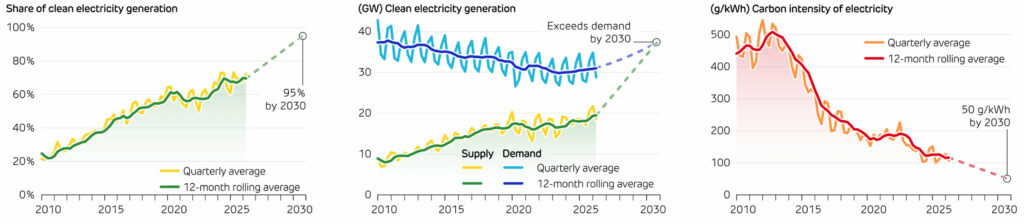
The Government has set three Clean Power 2030 targets, covering the amount of clean electricity produced and overall carbon intensity. Progress slowed in the last quarter as nuclear output fell, demand grew, and more gas-fired stations had to run.