A record year for renewable energy production
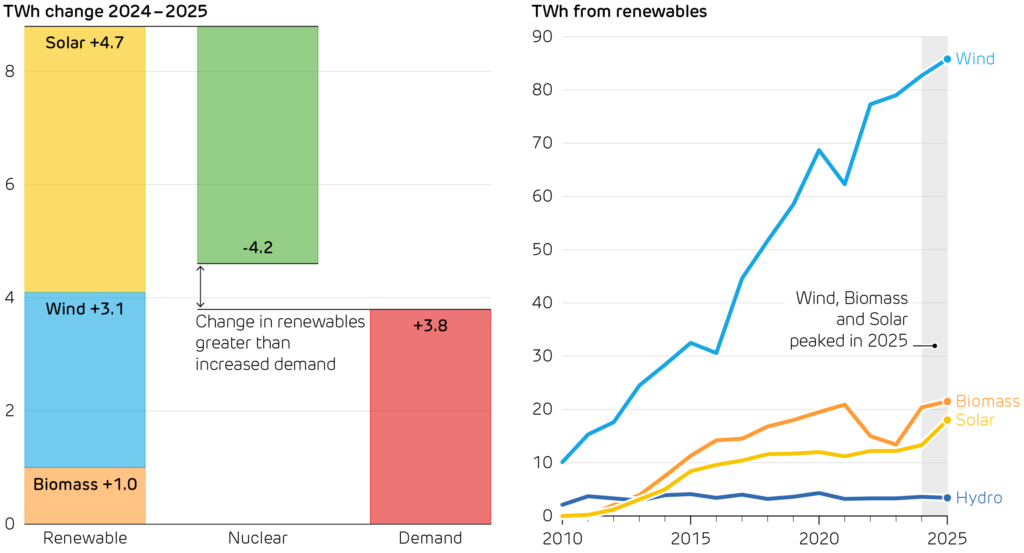
Electrification is central to decarbonising Britain’s homes and cars. But this raises the bar for the power system, which must produce more electricity while making it cleaner. In 2025, renewables did exactly that. Output from wind, solar and biomass all reached record highs, growing faster than demand. For the first time, clean sources supplied more than three-fifths of Britain’s electricity, up from just one-fifth in 2010.
Solar power had an outstanding year, with output 35% higher than in 2024. New installations surged as Britain basked in record sunshine. A quarter of a million homes installed PV in 2025, helping to push capacity up by 2.6 GW; the equivalent to two large power stations. The UK also enjoyed its sunniest year on record, with over 360 more sunshine hours than in 2024.
More wind and solar output cuts emissions and improves energy security, but puts greater strain on system operations. The cost of balancing supply and demand leapt by more than 20% to £14 per MWh – adding one-fifth onto generation costs. Much of this is down to the record cost of curtailing wind farms (£1.5bn in 2025), which continues to fuel debate about where new wind farms are built and how they should be supported.
Spiralling ancillary service costs points to the need for flexible and controllable clean power sources. Biomass also had a record year with output up 5%, but nuclear output slumped by more than a tenth to its lowest level since 1980. Britain’s nuclear fleet suffered prolonged maintenance outages, alongside refuelling and unplanned shutdowns.
The focus is shifting from building clean power to orchestrating a clean system. Curtailment, congestion, and balancing are becoming as important as generation records. System flexibility will determine whether more clean output translates into lower bills and lower emissions. If grid upgrades lag behind, curtailment will continue. Battery storage is Britain’s fastest growing source of flexibility and arguably the quickest route to turning wasted wind into delivered electricity. As gas power is phased down and nuclear stations reach retirement age, we will increasingly need technologies that can deliver clean power on demand, not only when the weather cooperates.
Britain’s renewables supplied all the growth in electricity demand in 2025, even compensating for the drop in nuclear
output. Three renewable energy sources supplied record amounts of electricity.