AI and data centres push up Britain’s electricity demand

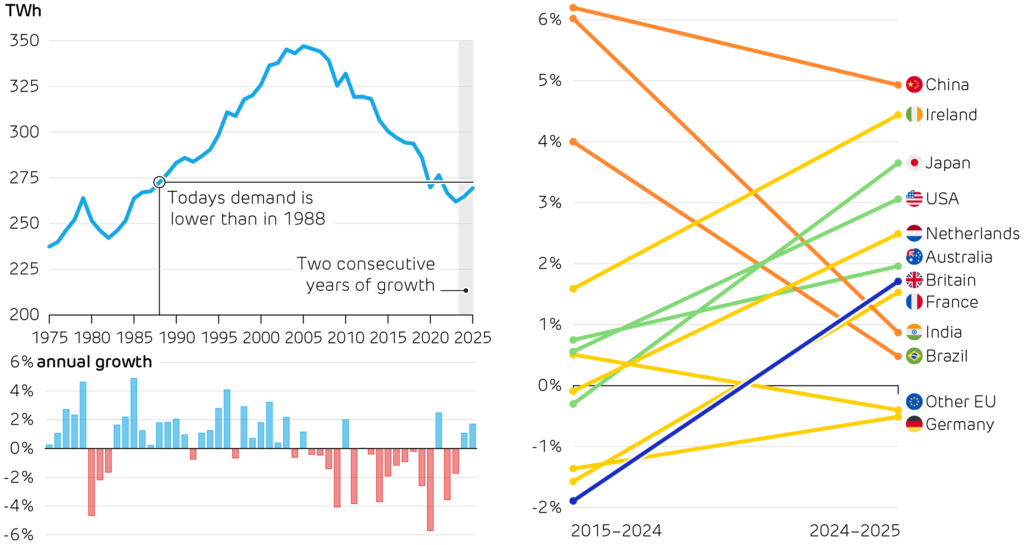
Britain’s electricity demand has reached a turning point, seeing two consecutive years of growth for the first time in over 20 years. Since its peak in 2005, demand has fallen by more than a fifth – often seen as a sign of wider decline, deindustrialisation and outsourcing. Now with Artificial Intelligence poised to reshape the economy, the data centres which power AI models have contributed to raising Britain’s electricity demand by 1.7% in 2025.
AI presents a major growth opportunity, expected to boost UK GDP by £550 billion over the coming decade. Behind the rapid increase in AI assistants are data centres: huge and power-hungry computer clusters concentrated around London. They currently consume 2.5% of Britain’s electricity, more than the city of Birmingham.
Britain’s electricity demand is also being driven upwards by electrifying transport and heat. Electric vehicle sales grew by 27% to reach 475,000 pure-battery vehicles plus 225,000 plug-in hybrids, meaning one in three cars sold in 2025 was electric. Heat pump sales grew more modestly, by just 4%, held back by Britain’s high electricity prices.
Data centres are growing much faster, already consuming 5% of national demand in the US, and 20% of Ireland’s electricity. This is wreaking havoc on electricity systems: American firms are scrambling to build polluting diesel and gas generators to meet growing demand, and Ireland placed a three-year ban on new data centres to protect consumers.
To sidestep these problems, the Government launched five AI growth zones: areas with good grid connections, clean firm generation sources, and proximity to cities. Yet, with UK data centre demand forecast to quadruple by 2030, more zones are likely to be needed to keep pace and avoid stretching the grid thin.
Britain’s electricity demand has gone from falling faster than in any other major country, to now being middle of the pack. Britain’s turnaround is set to accelerate, as the CCC targets rapid rises in heat pump installations and electric car sales. Building all-new infrastructure to power these new loads will be prohibitively expensive, but planning ahead to use off-peak hours and better utilise existing infrastructure around the country will help to avoid the grid from holding back progress.
Britain’s annual electricity demand over the last 50 years.
Growth in electricity demand last year compared to the
previous decade across several countries.