Solar’s growing role in Britain
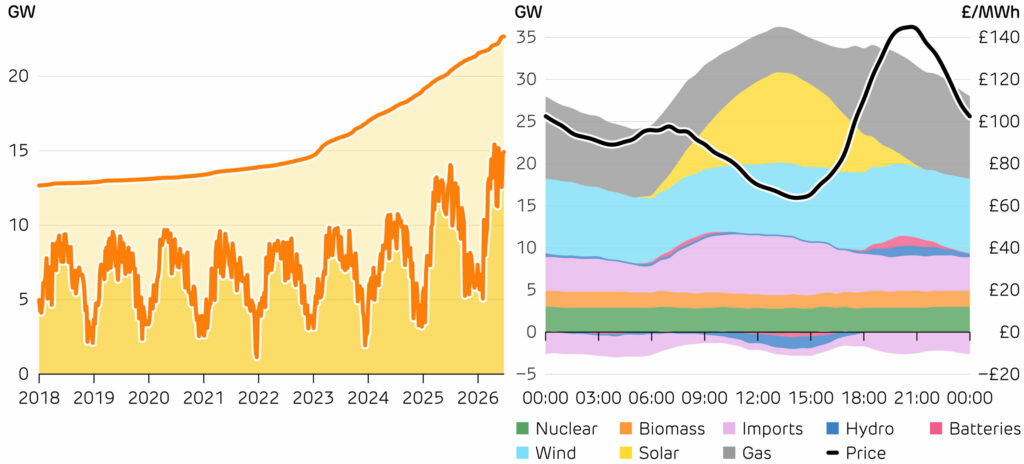
After years of stagnation, Britain’s solar sector has returned to rapid growth. Last quarter saw record generation, surpassing 15 GW on an April afternoon. However, June’s heatwaves exposed what solar cannot provide: output during the heightened evening peak, leaving price spikes until flexibility catches up.
Momentum is building, with nearly 3 GW of solar farms under construction, and a new rooftop system installed every two minutes. The Government’s Solar Roadmap aims to put panels on three million homes by 2030, adding around 10 GW of capacity. Next year, new homes in England will come with PV, and plug-in solar panels are now on sale. These have taken off in Germany, with nearly half a million systems sold last year.
Solar is helping Britain to reduce its need for gas, but recent heatwaves demonstrate both its value and limits. Solar output rises in the morning with demand, keeping down the need for gas during the day and helping meet extra demand from Britain’s growing fleet of air conditioners. But generation falls rapidly towards sunset when demand remains high, especially on hot evenings.
This mismatch is reshaping Britain’s electricity prices. Solar generation pushes down daytime prices as less fossil fuels are needed, deepening the so-called “duck curve”. As solar’s share grows, stretches of negative power prices are becoming longer and more frequent. A MWh produced after 7pm is worth twice as much as one produced at 2pm, so the value of solar now depends on shifting power into the evenings. Solar is becoming a victim of its own success: each new panel reduces the value of electricity from existing ones, and pushes costs onto the rest of the system.
Fixing this requires more flexibility. Batteries and pumped hydro storage each supplied an average of 1.2 GW during evening peaks, but this pales in comparison to the drop in solar output. Britain has many interconnectors, but these export more on average during evenings, as neighbouring countries face the same issue of meeting peak demand.
Batteries already supply over 20% of the evening peak in California, and 7% of peak demand in Australia. Even so, their networks have introduced export limits and emergency controls to curtail rooftop output when midday supply overwhelms demand. The lesson for Britain is that storage must expand alongside solar, not after it. The real test for the coming years is not whether Britain can avoid fossil fuels at noon, but whether solar plus storage keeps the gas-fired power stations off into the evening.
Installed capacity and peak output from solar PV over the
past decade. PV output surpassed 15 GW for the first time this quarter.
Britain’s “duck curve”, showing the average grid mix
(shaded areas) and wholesale price (line) in each half-hour of the day over June 2026.