Introduction
The world is in the grip of the second fossil-fuel crisis so far this decade. The US-Israeli war in Iran has closed the Strait of Hormuz, which had carried some 20% of global oil and seaborne gas. Natural gas prices doubled in Britain, and the Government is now changing how it supports older renewable generators to try and weaken the link between gas and electricity prices. Our second article looks at the longer-term solution: cutting Britain’s exposure to geopolitical energy shocks by reducing our reliance on fossil fuels.
At the same time, the power system faces growing pressure from rising demand. The Government has high ambitions for AI, wanting at least 6 GW of AI-capable data centres by 2030. These could jeopardise national carbon targets and further strain the grid unless managed properly. Our third article explores the choices over where large data centres are built and how they operate, which could turn them into assets that help smooth out demand and the costs of decarbonisation.
Britain’s renewables have been smashing records through March and April. The grid got tantalisingly close to operating without fossil fuels in the first week of April, as generation from gas fell below 1 GW. Alongside power companies giving away free electricity on weekends, the Government is trialling free or discounted electricity for people in congested areas, to help avoid wind power being wasted. This shows that flexibility is more important than ever.
Energy storage and interconnection are two of the main ways to manage more renewables on the system. Finally, the political headwinds are shifting towards closer integration with Europe, which might allow those links to be used more effectively in future. Despite being an island nation, our fifth article shows how Britain has overtaken Germany to become the most interconnected large power system in Europe.
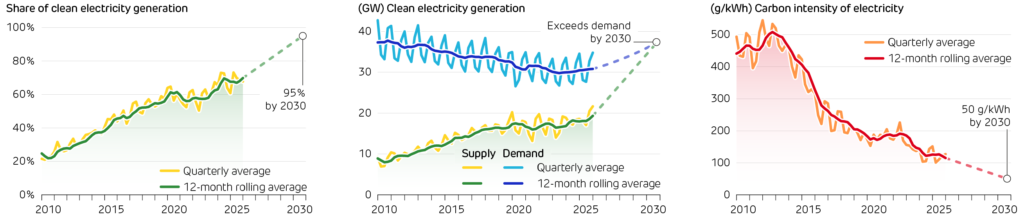
The Government has set three Clean Power 2030 targets, covering the amount of clean electricity produced and overall carbon intensity. The grid continued to decarbonise in early 2026: the rolling annual share of clean generation rose by 1.7 percentage points, while carbon intensity fell by 6 g/kWh.