Insulating Britain from geopolitical energy shocks
Just as Britain was emerging from the energy price crisis following Russia’s invasion of Ukraine, the war in Iran gives a fresh reminder that our bills are firmly dictated by global markets. More than ten weeks into the war, diplomacy remains stalled and tankers remain trapped. Attacks and cargo seizures have kept energy markets on edge. More than a billion barrels of Gulf oil have been held back, with the squeeze being felt by businesses, households and holidaymakers alike.
Fatih Birol, head of the International Energy Agency, warns that the world is facing “the biggest energy security threat in history”, which has irreversibly changed the fossil fuel industry. However, Britain is not at imminent risk of energy shortages. NESO confirms that electricity supplies are secure, with sufficient operating surplus due to clean generation sources. Other countries are feeling the shock more directly and have resorted to emergency energy saving measures. India capped gas use in industry, the Philippines introduced a four-day working week, and the EU is encouraging people to work from home.
Energy prices have taken a hit though, as one-fifth of the world’s oil and LNG supplies remain trapped in the Strait of Hormuz. However, the impacts are very different from the 2022 European energy crisis. This time around, petrol and diesel prices soared by one-fifth and one-third at their peak, adding £15 and £30 respectively to the cost of filling a 60-litre tank.
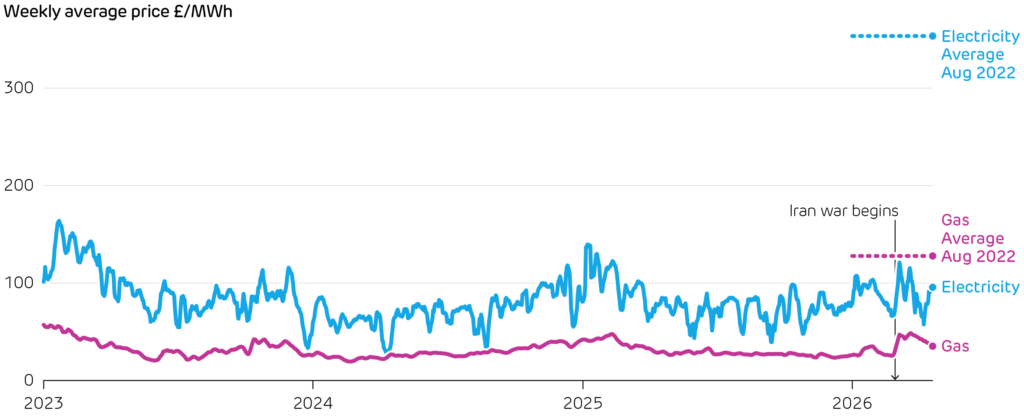
Natural gas prices doubled in the space of two weeks to over £50/MWh, although they quickly began falling back to pre-war levels. This spike was typical for recent winters, and nowhere near the levels seen in 2022 when gas averaged £128/MWh, and electricity reached over £350/MWh.
The impact on Britain’s power prices has been more muted, rising by 20% between February and March. High renewable output helped to limit the ability of gas to set wholesale power prices. Still, even this modest rise comes on top of already sky-high bills, as British consumers face among the world’s highest energy prices. Household electricity bills fell slightly on 1 April as some policy costs were moved into general taxation, but as Ofgem’s price cap lags wholesale prices, the Iran crisis is forecast to push bills 12% higher in July.
The Government is trying to weaken the link between gas and electricity prices by moving older wind and solar farms onto voluntary fixed-price contracts. Their earnings would no longer rise when gas prices are high, and those which do not opt in will instead face a windfall tax on extra profits when prices are elevated.
Wholesale energy prices increased sharply at the start of the Iran war, but only to typical levels during the previous two winters, and well below their peak in 2022.
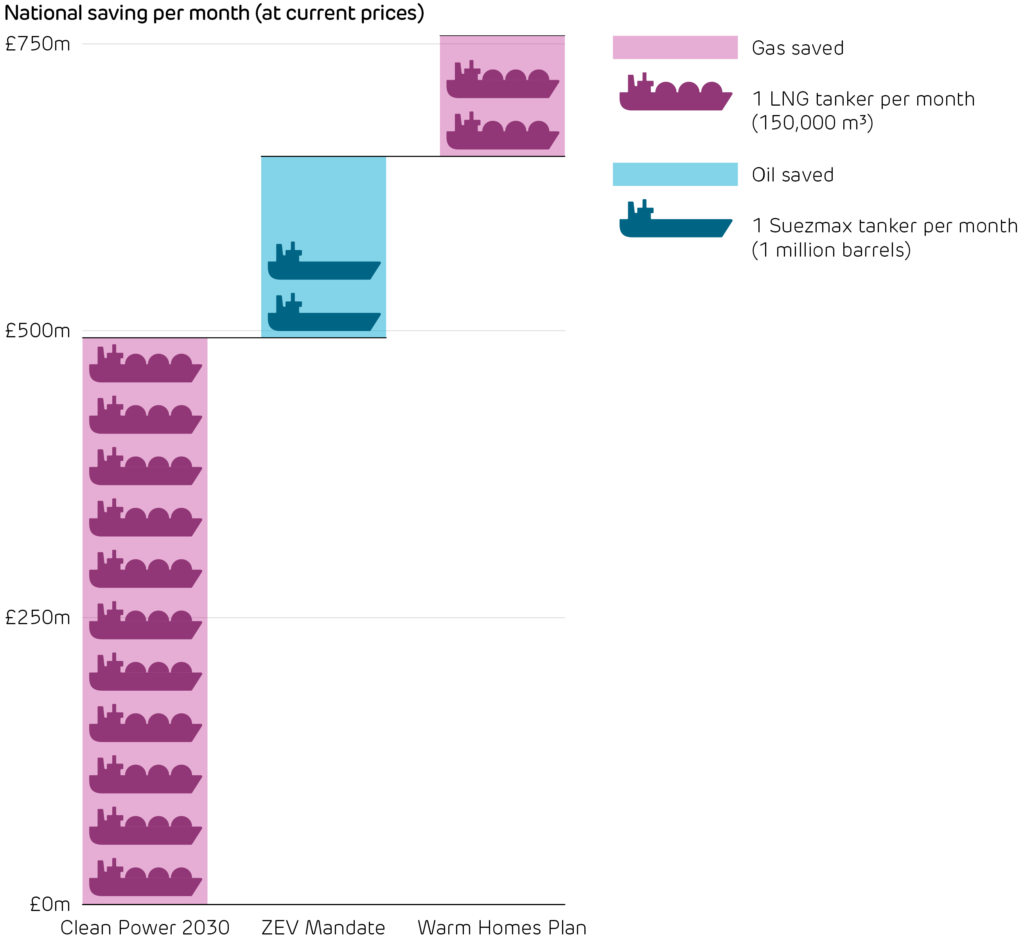
These tweaks will help to stabilise bills, but will not equip Britain to sidestep the next fossil fuel crisis. Diversifying our energy supply is the long-term route to insulate consumers from geopolitical instability and price spikes. There is broad consumer interest in this direction, shown by the increasing demand for rooftop solar panels, electric vehicles, heat pumps and building insulation. Policy is a critical enabler, and government targets for these technologies could collectively shave hundreds of millions of pounds per month off the national spend on imported fossil fuels by limiting their use to only when needed.
The biggest impact comes from the Clean Power 2030 targets to roughly triple wind and solar capacity by 2030. If supported by sufficient flexible generation and storage, these could avoid around 11 TWh of gas being burned for electricity each month, saving close to half a billion pounds at current prices. Gas will still be needed for around 5% of our electricity in 2030, but its role will shift to providing flexible backup for intermittent renewables, rather than generating (and setting the price) in all hours of the year.
The Zero Emission Vehicle Mandate would put over 6 million electric vehicles on our roads by 2030, saving around 3 TWh (or 2 million barrels) of oil per month. The Warm Homes Plan aims to clean up home heating, upgrading 5 million homes from EPC band E to C, and switching around 1.5 million over to heat pumps by 2030. Each of these will reduce the amount of gas households need by around 1 TWh per month.
What look on the surface to be just environmental policies are now clearly both energy security and energy affordability policies. Doubling down on clean electricity production and electrification of other sectors is Britain’s best way to avoid the next fossil fuel crisis.
The Government’s targets for 2030 would reduce the need to import 15 tankers of LNG and oil each month, with a value of £750m per month based on current prices.