Getting better connected with Europe

Britain left Europe’s shared electricity market back in 2021, yet since Brexit, its power system has become more inter-connected than ever. The Government is now considering a closer relationship with Europe, which should allow our cross-border cables to be used more effectively. With rising demand and variable renewables pressuring the grid, better electricity trading could help to lower bills and strengthen security.
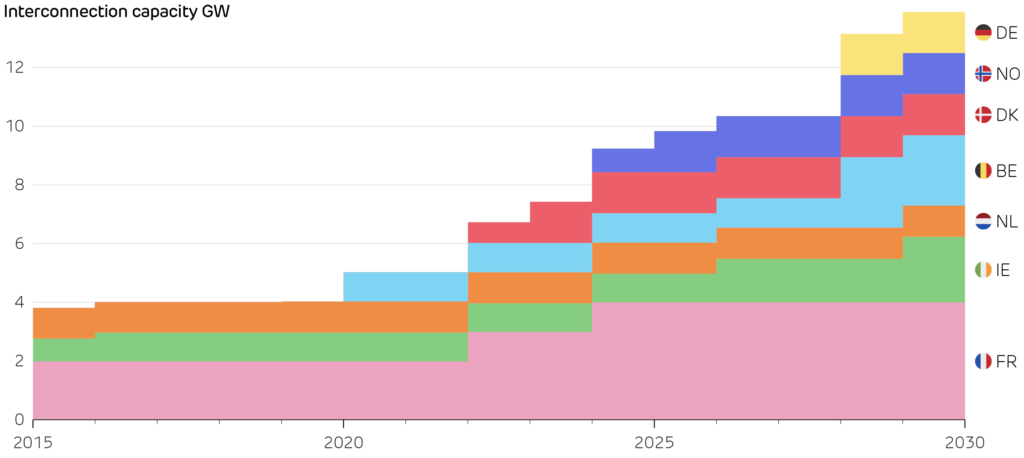
Cables to Europe have moved from the margins to the centre of our power system. Britain now has 10 interconnectors with 10.3 GW of capacity linking into neighbouring systems. France and Norway are now two of Britain’s largest sources of electricity, supplying 8% and 3% of demand in 2025, respectively. Our links to Belgium, the Netherlands and Denmark are used as two-way trading routes that balance intermittent wind and solar, importing 4% and exporting 2% of our national supply over the year. Finally, three links to Ireland export a further 2%.
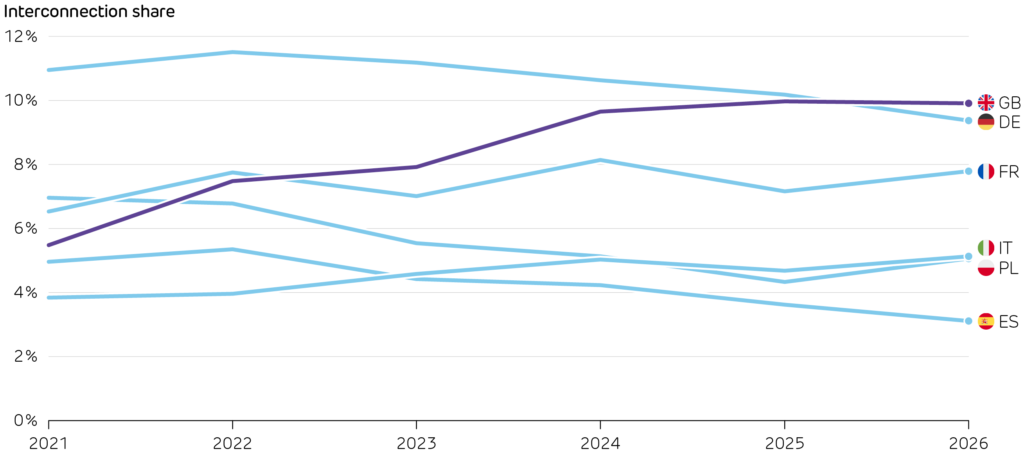
These links put Britain in an unexpectedly strong position. The EU asked all member states to build cross-border interconnector capacity equal to at least 10% of their total generating fleet by 2020, rising to 15% by 2030. This year, Europe’s five largest power systems all fell short of the 2020 target. Despite not being bound by EU rules, Britain reached the 10% target, and has now overtaken even the well-connected German power system. This is doubly surprising for an island nation, as subsea cables are twice as expensive to build (per km) as overhead lines.
Britain’s interconnection started expanding rapidly in 2020, with new links to Belgium, Denmark and Norway, plus two new links to France coming online in a few short years. Britain built 5 GW of interconnectors between 2021 and 2023, but since then only 0.5 GW has come online. The NeuConnect link to Germany is currently under construction, but not scheduled for completion until 2028. The lull should be short-lived, as Britain is due to add more than 1.2 GW per year from 2028 through to 2032 if all approved projects proceed as planned.
Britain overtook Germany to become the most inter-connected large power system in Europe. Interconnection share is measured as the total interconnector capacity relative to total generating capacity. France’s total includes links to Britain.
Building links to other countries is only part of the challenge. Britain also needs more grid capacity to move power within its own borders. Stronger connections are needed to reduce the amount of Scottish wind power wasted to curtailment, to connect new sources of demand like AI data centres, and to support the landing points for major new interconnectors. This will require strategic long-term planning, and a planning system that can deliver clear and timely decisions to build the infrastructure that the power system’s future depends on.
The next question is whether Britain can use those cables more effectively. The UK and EU are exploring closer cooperation, including the possibility of Britain participating in the EU’s internal electricity market once again. This would improve the efficiency of electricity trading, which National Grid estimate has added £1 billion to the cost of power trading since Brexit. Recoupling markets would allow the intuition and forecasts of traders to be replaced by central algorithms, which would reduce power prices in Britain.
Britain’s Reformed National Pricing plan could shorten market settlement periods to 15 minutes, aligning with how markets run on the continent. Both sides also plan to link the UK and EU Emissions Trading Schemes, together with abolishing Carbon Price Support from 2028 – an £18 per tonne tax paid only by British fossil-fuelled power stations for CO2 emissions. These changes would align carbon price signals for power generation on both sides of the Channel, reducing distortions in interconnector trade and creating a more level playing field between the markets.
Britain’s interconnectors are now central to operating the power system and setting electricity prices. We can already import up to one third of national electricity demand, so using our links efficiently is becoming as important as building new ones. This must also go hand in hand with more home-grown clean power, as merely swapping our reliance on imported fossil fuels for reliance on imported electricity will not solve Britain’s energy security and energy price challenges. Ultimately, a diverse portfolio is needed, with flexible generation, battery storage, demand response and stronger networks to keep the system reliable as clean power grows.
Britain’s interconnection with neighbouring countries grew rapidly between 2020 and 2025, but is now stalled until new links come online from 2028 onwards.