Britain’s AI ambitions depend on the grid

Britain’s AI boom could bring major economic benefits, but only if the power system grows with it. OpenAI’s Stargate UK was set to be the centrepiece of the North East’s AI Growth Zone, but is now paused, partly due to energy costs. Nearly £10 billion of data centres were approved in 2025, but less than £1 billion were actually built. There are also growing worries that the large data centres needed to run AI models will make the Clean Power 2030 targets and the UK’s carbon budgets harder to deliver. They could increase emissions much more than had initially been expected, while competing with electrification of heat and transport.
Seeking AI growth, but not at any cost
The UK aims to be a world leader in AI, which requires major investment in compute and data infrastructure. Government forecasts see at least 6 GW of AI-capable data centres needed by 2030, enough to hoover up all the output from four large nuclear reactors. This new computing power must not push up bills, lock us into high-carbon power, or delay other users from connecting to the grid. Such problems are already fuelling an AI backlash in the United States, Ireland, and now the UK.
Data centres are becoming a contentious pressure in Britain’s grid connection queue. NESO reports that 140 data centre proposals seek ~50 GW of grid connections – equal to Britain’s entire peak demand. Half are already financially committed, but some face waits of up to 15 years for grid access, which is driving investment overseas. Reforms to Britain’s connection queue should help data centres, which are now treated as strategic demand. However, the sheer scale of queues and delays means growing uncertainty over how many projects will actually be built.
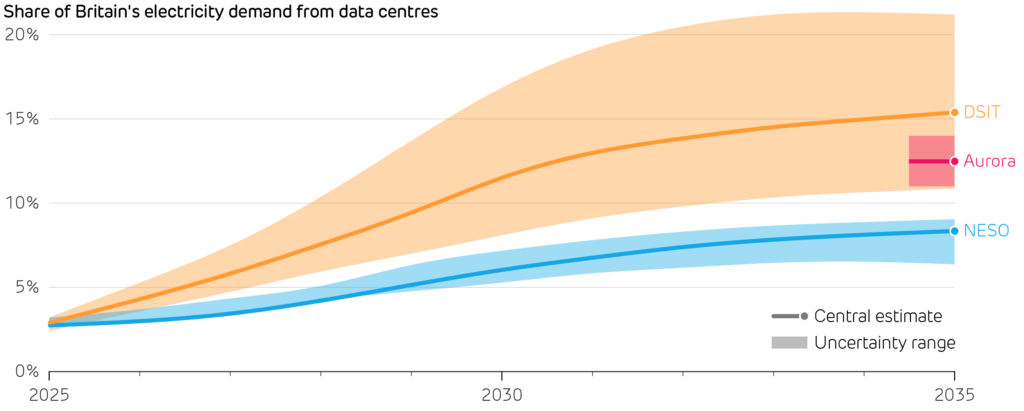
Various projections expect data centres to grow rapidly over the coming decade to reach around 8–16% of Britain’s total electricity demand.
Location, location, location
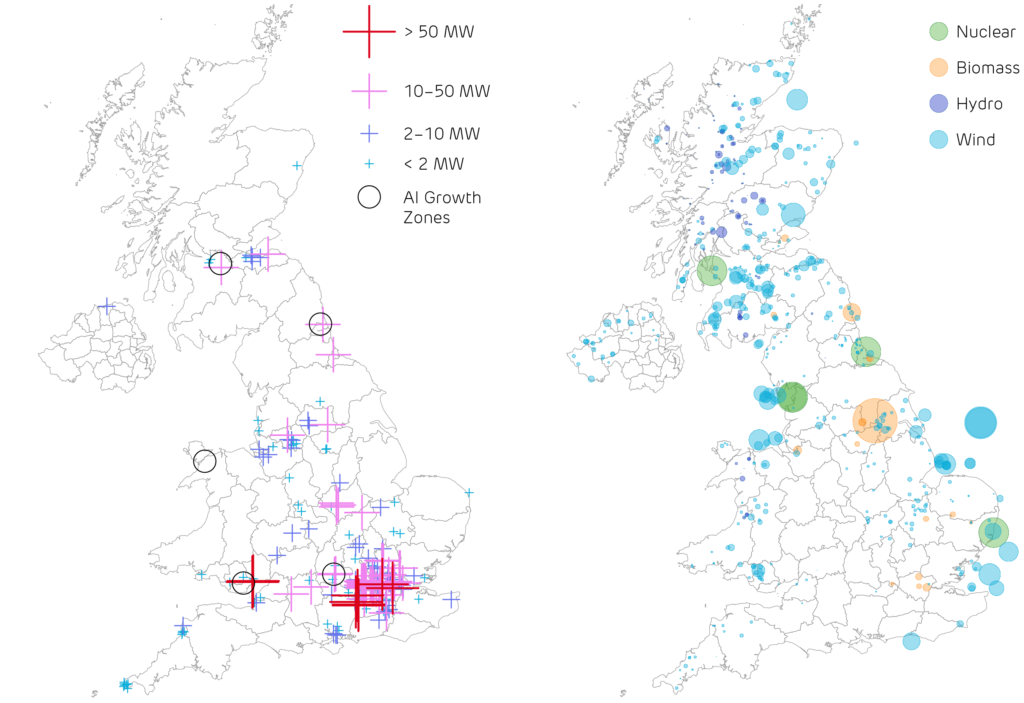
The best data centre locations require the three Ps: power, planning and ping (the time taken for data to reach customers). Some two-thirds of existing data centres lie within just 20 miles of London, as it is close to consumers and digital infrastructure. This adds pressure to an already strained grid. New housing in west London has been stalled because large data centres have taken all spare grid capacity.
Many AI users would be unaffected by a fraction of a second spent transferring data to another part of the country. Greater priority should go to regions with strong existing grid connections and low-carbon generation.
Ofgem is considering ways for large electricity users to connect more easily by building their own grid assets or sharing existing grid connections. The Government has also created five AI Growth Zones to distribute new investments, offering faster planning and discounted electricity. These steps should bring forth investment, but more projects should look beyond London. Steering new data centres to places that best use Britain’s low-carbon generation will avoid electricity being a bottleneck.
The UK’s data centres are heavily concentrated around London, unlike its clean power stations. 1.7 GW of the UK’s 2.4 GW of data centres lie within 20 miles of the capital. Cross and bubbles are sized according to power capacity.
Making AI workloads support clean power
Data centres are seen as a problem, but designed well, they could instead be part of the solution. Rather than building ever more power stations to meet demand, the grid needs large users that can help when the system is under stress. Google has shown that machine-learning workloads can be shifted or limited in response to grid stress. National Grid has begun similar UK trials, cutting demand by a third in seconds, without disrupting critical calculations.
Clean power systems are capital intensive. Much of the cost comes from building networks, storage and clean-firm generation to cover the hardest hours of the year, when demand is high while wind and solar output is low. Flexible data centres could shift demand away from these periods, allowing better use of these assets that would otherwise sit idle for much of the year. By spreading fixed infrastructure costs over more hours and users, data centres could lower the cost of accommodating growth.
The prize of the AI race is higher productivity that brings much-needed economic growth. To lead in AI, Britain must accommodate a large new demand without crowding out electric vehicles or heating, and without pushing costs onto regular consumers. This means prioritising projects that are ready to go and system-friendly: located near existing grid connections and clean firm electricity sources, and able to shift workloads in response to grid conditions.