Britain’s era of energy system devolution
July brought another change at the top of British politics, as Andy Burnham succeeded Keir Starmer as Prime Minister. Burnham inherits a clean power programme that is going strong, with ambitious 2030 targets that are broadly on track. His first moves were to abolish the 5% VAT on household electricity and call for stronger public control over energy. But his larger project is devolution. Britain’s power system offers an early test: can greater regional influence turn an almost £2 billion grid congestion problem into a force for local growth?
Britain operates a national electricity market, but the physical system is highly regional. Wind power is concentrated in Scotland and coastal areas, whereas the largest demands are in the major urban areas of central and southern England. When the network cannot carry enough electricity, clean generation in the north must be turned down and replacement power (typically expensive gas) called upon in the south. This divide comes at a cost, which will only worsen if supply and demand grow in opposite ends of the country.
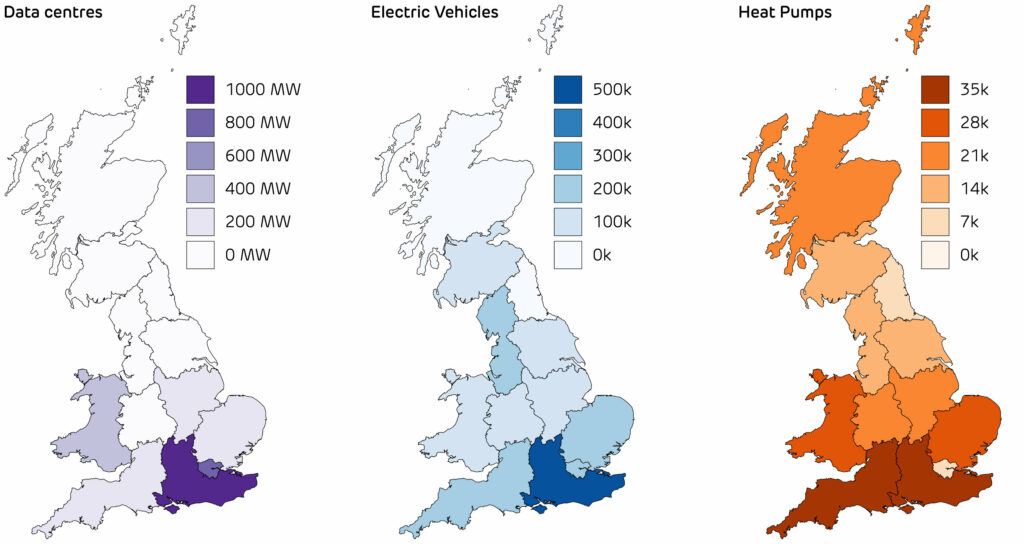
New sources of electricity demand are strengthening this north-south divide. Data centres are growing rapidly and are overwhelmingly concentrated around London. Electric vehicles and heat pumps are also being adopted at very different rates across the country. There are ten times more EVs in the south east than the north east of England, which amounts to more than three times as many per capita.
Some of this new demand is geographically flexible. Households and people’s commutes cannot move, but new data centres, factories and electrolysers for producing clean hydrogen could be steered towards areas with abundant generation or spare network capacity. The billion dollar question is how to persuade new demand and infrastructure to make use of the renewable energy we produce, rather than worsen congestion and push up bills.
The previous government rejected zonal pricing, which would have used regional price signals to influence those decisions. Its forthcoming Strategic Spatial Energy Plan will map where generation and storage are needed, but a map alone will not guide investment. Delivery will depend on whether network charges, connection offers and support schemes give developers sufficient reason to build in those places.
The uptake of “electrotech” is highly uneven around Britain, with data centres and electric vehicles concentrated in the south east of England, and heat pumps in southern England and rural parts of Scotland and Wales.
Britain must build roughly twice as much new transmission infrastructure by 2030 as it managed over the previous decade, alongside up to 27 GW of grid-scale batteries. Building these, along with new renewables and clean capacity, could create
100,000 construction and maintenance jobs, with the government expecting clean-energy employment to almost double by 2030. Where infrastructure is built will shape where jobs appear, but not always where the benefits go, so devolution must ensure that regions capture the benefits of what they host.
Regional Energy Strategic Plans will bring regional and local government into decisions on networks, transport, heating, industry and economic development, with the first full plans expected in late 2027. Local leaders are closer to the communities affected by these decisions. They know where growth is being held back, which investments matter most to local people and which new infrastructure their communities are likely to support or oppose.
Devolving power and directing network investment towards choice sites could bring projects forward, attract further private investment and create jobs. But regions must gain real influence without weakening the national coordination needed to keep power secure and costs down.
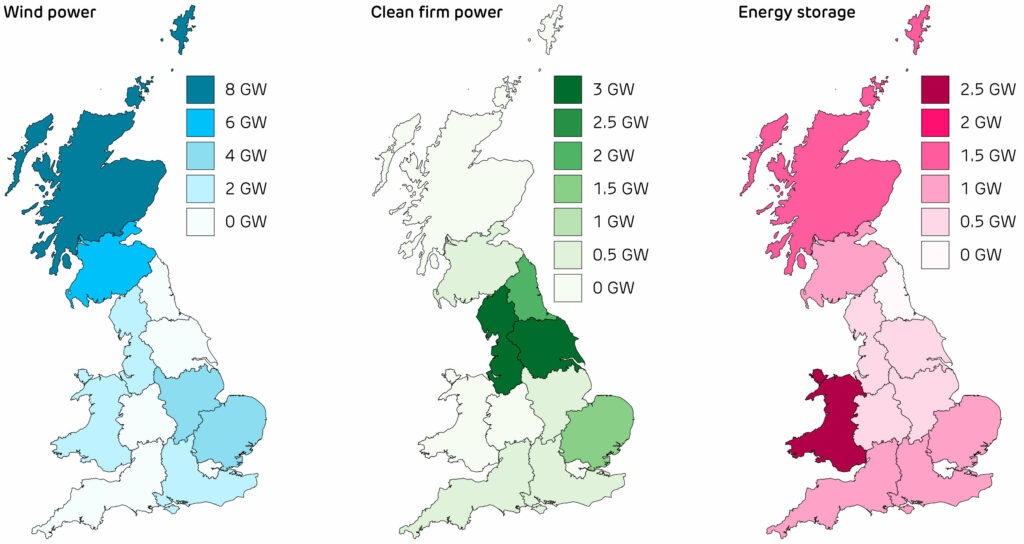
Britain’s electricity generation is also unevenly distributed, and located far from demand centres. Wind farms are concentrated in the north of Scotland. Clean firm capacity (nuclear, biomass, and other low-carbon dispatchable
technologies) are primarily in the north of England. Energy storage is more widely distributed, with large pumped-
hydro stations in Wales and Scotland.