This quarter revealed both sides of Britain’s clean-power transition. On 22 April, zero-carbon sources supplied 98.8% of electricity for half an hour, with gas squeezed to barely more than 1% of the country’s generation. By June, the picture looked very different. Power prices spiked above £500/MWh, the highest wholesale price ever recorded in June, while record heat forced NESO to issue its first ever summertime Electricity Margin Notice. Britain is increasingly capable of running on clean power, but operating that system securely and affordably is a growing challenge. We interview Drax CEO, Will Gardiner, in our second article, asking what needs to change as the transition moves from building renewables to building a flexible, resilient system around them.
Solar is becoming an increasing part of this challenge. Output hit a record 15.4 GW in April, and pushed the electricity system to its lowest ever transmission demand of just 12.6 GW. But the sun sets just as peak demand arrives, creating a widening gap between cheap, abundant solar power at lunchtime and expensive, high-carbon power in the evening. Our third article looks at Britain’s growing “duck curve”, and why storage must expand alongside solar rather than after it. Ofgem’s decision to back 7.6 GW of new long-duration storage projects could not have been better timed.
The summer heatwaves reveal another side of the problem. Extreme temperatures increase electricity demand for cooling while simultaneously reducing output from power stations and the capacity of networks. Our fourth article asks how Britain can prepare for hot, still evenings that were once unusual but are becoming a growing system risk.
Finally, the power system remains geographically divided which exacerbates system stress. Wind generation is concentrated in the north while new demand, particularly from data centres and electric vehicles, leans south. With grid congestion already costing almost £2 billion and Andy Burnham putting devolution at the heart of his new government, our final article asks whether giving regions more influence over energy investment can turn today’s network bottlenecks into tomorrow’s local growth.
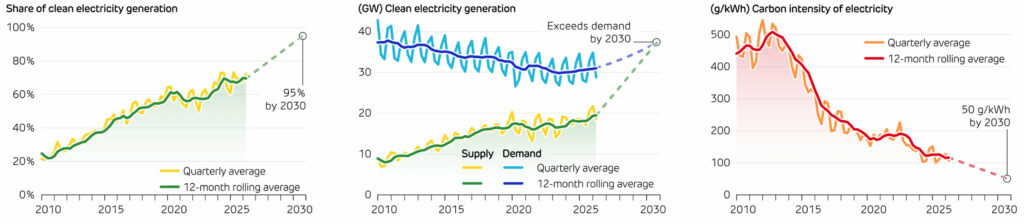
The Government has set three Clean Power 2030 targets, covering the amount of clean electricity produced andoverall carbon intensity. Progress slowed in the lastquarter as nuclear output fell, demand grew, and moregas-fired stations had to run.
Britain’s energy system is being pulled in every direction at once: we have record levels of renewable generation but bills remain stubbornly high, security is back at the top of the agenda, and we have struggled through record temperatures. This edition of Electric Insights features a Q&A with Will Gardiner, CEO of Drax, about what Britain’s latest electricity trends tell us about where the system is heading – and what it will take to make net zero power more affordable and reliable. This article explores the main themes discussed in the accompanying Q&A video.
From clean generation to a clean system
Britain has made real progress in decarbonising its power system. There is now a real opportunity to turn some of the country’s energy challenges into solutions that strengthen energy security, support growth and deliver wider benefits. Homegrown renewable electricity is doing much of the heavy lifting, reducing reliance on imported fuels and improving energy security, while also helping lower emissions and bills.
But the next stage goes beyond building more generation. It is about creating a flexible, resilient and affordable system. This means looking beyond single technologies, to the whole-system challenge where renewable generation, dispatchable low- carbon power, storage and flexibility all work together.
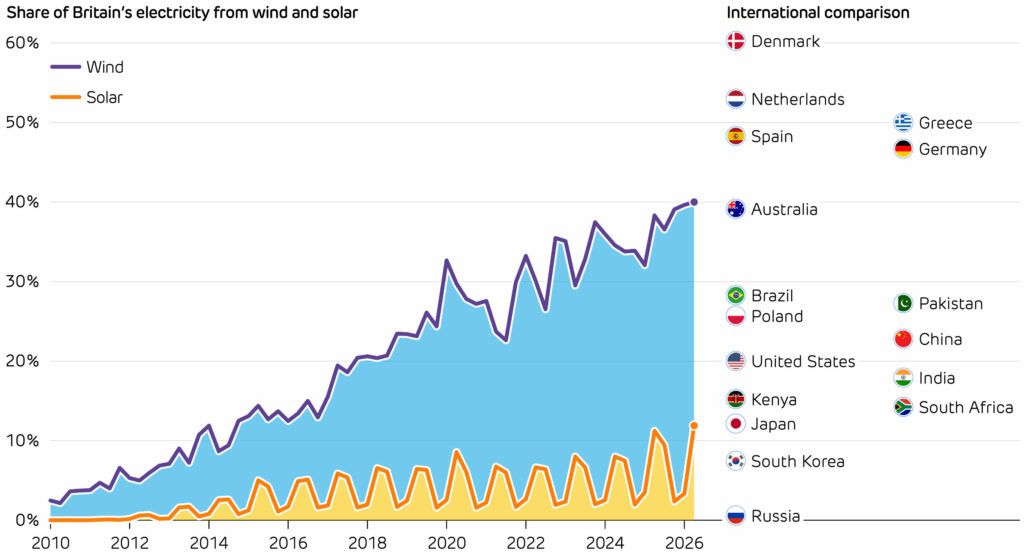
The Electric Insights data suggest that Britain is heading in the right direction. Wind and solar now produce 40% of our electricity, cutting the need for imported gas. But the data also show the practical challenges this is causing: renewables are being curtailed, there are more hours with negative power prices, and growing strain on system balancing. The overall direction is encouraging, but we are paying the price for falling behind on flexibility.
The share of Britain’s electricity demand met by wind and solar power reached 40% in the second quarter of 2026, ahead of most major world economies. International comparisons cover 2025, or the most recently available data.
Making the economics work
Britain has some of the highest electricity prices in the world, and geopolitical shocks are pushing prices up further, making bills the biggest issue for most people. Rising offshore wind prices, expensive grid reinforcement and curtailment costs have raised questions about whether the economics of the transition still stack up.
There are no easy solutions here, and the key question is which investments will reduce costs and risk over time. Relying on volatile fossil fuel markets is expensive, as consumers have felt directly. Renewables reduce that exposure but incur different costs, so a balanced approach is needed which invests in the grid, storage, demand response and dispatchable low-carbon generation.
Together, these improve flexibility which helps balance the system as supply and demand change, making renewable power dependable. Policy certainty and investable market frameworks matter more than ever, because they give companies the confidence to deliver the infrastructure Britain needs to fix affordability and security of supply.
A huge, coordinated effort is needed to meet our infrastructure needs. The UK Government’s Clean Power 2030 targets imply adding roughly 60 to 70 GW of solar and wind this decade, more than doubling current capacity. The technologies are already mature – delivering at the necessary pace is now the hard part.
The barriers are familiar: planning, timely grid connections, supply chains and investor confidence. Overcoming them is not impossible, but this needs clearer policy, faster decisions, and a relentless focus on practical cost-effective delivery. The transition will only succeed if ambition can be turned into projects on the ground quickly, responsibly and affordably.
Demand is becoming part of the challenge
Electricity supply has commanded most attention, but demand is a growing part of the story. Electrifying heat, transport and industry means demand could rise rapidly. Electricity has to become the obvious economic choice, not just the low-carbon choice.
That means addressing the balance of policy costs on electricity versus gas, supporting consumers, and preparing the system for growth. It also means being smart about new demand from AI and data centres, making sure they connect where clean firm power and grid capacity are available. As demand grows, there is a strong case for generating more electricity closer to where it is needed, reducing pressure on the network and improving system resilience.
Gardiner argues that for Drax, that reinforces the importance of firm, flexible generation and long-duration storage, assets such as sustainable biomass and pumped storage. A renewable power system still has to be there when people and businesses need it.
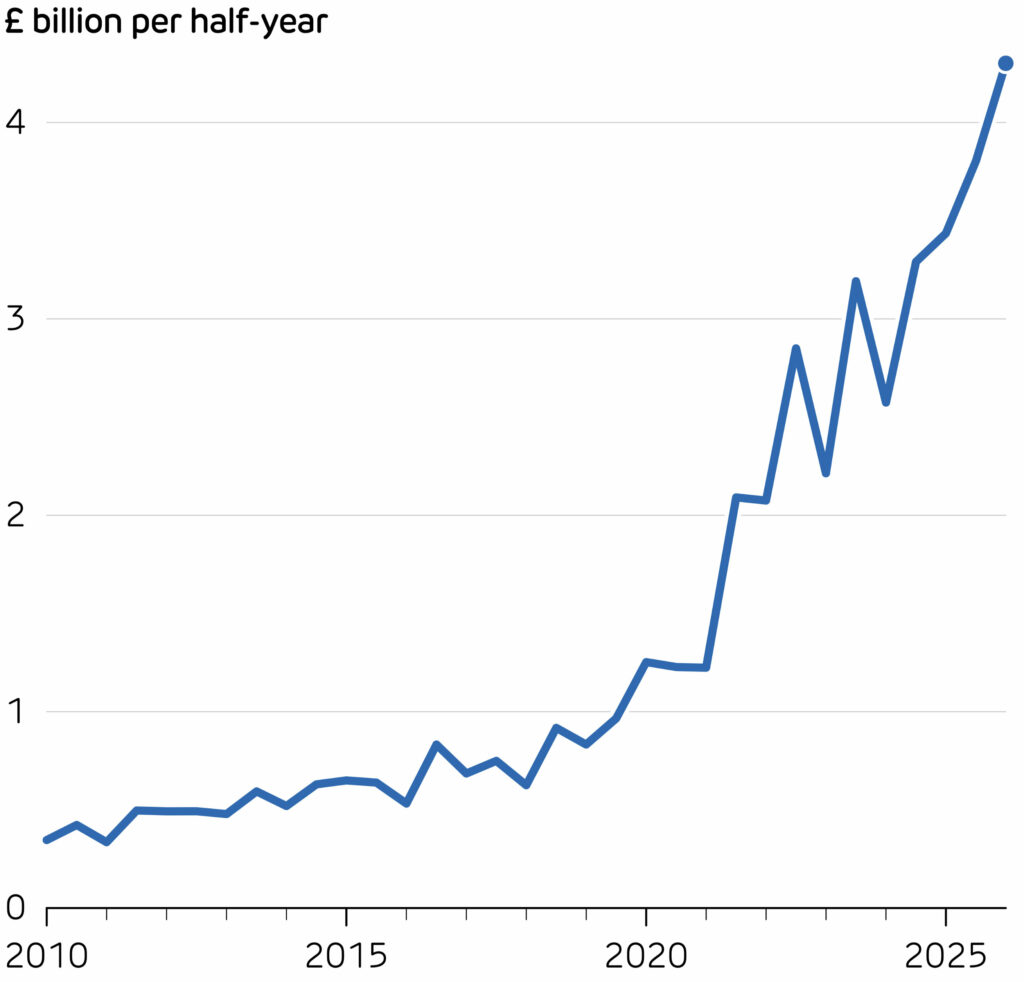
The cost of balancing Britain’s electricity system surpassed £4 billion in the first six months of 2026 – around £25 a month from every single household. This pays for adjusting generation and demand to match exactly, including curtailing wind farms when needed.
Preparing for when the weather does not cooperate
We all know that the wind doesn’t always blow, and the sun doesn’t always shine, batteries are excellent for covering short peaks. But Britain is a windy country, so there will be shortfalls lasting for days or weeks at a time when it’s cold and still. To cope with our weather, we need to get serious about long-duration storage and clean dispatchable generation so that supply remains secure in all situations.
This challenge is becoming more important as Britain’s climate changes before our eyes. This summer’s heatwaves and droughts are a warning that climate resilience must become central to planning. Hotter summers, winter storms and changing rainfall all affect demand, generation and infrastructure. We can no longer design for the weather we remember from childhood. The power system needs to cope with the more extreme conditions and wider swings that the future will throw at us.
The challenge therefore has two sides. A power system increasingly dependent on weather-driven generation needs flexibility to manage natural variations in wind and sunshine, while the infrastructure itself must become resilient to the more extreme climate.
Turning clean power into an industrial advantage
Britain has the chance to turn a challenging energy transition into an industrial advantage. The country has deep expertise in power markets and engineering, plus sites and skills that can be repurposed rather than abandoned.
If the grid and flexible assets can be built at pace alongside renewables, clean power can support new industries from data centres to advanced manufacturing. More importantly, it can protect consumers from the next shock in global gas markets. Gardiner believes that is exactly the kind of joined-up approach the transition now needs: one that attracts investment, keeps the system secure, and gives homes and businesses confidence about what energy will cost.
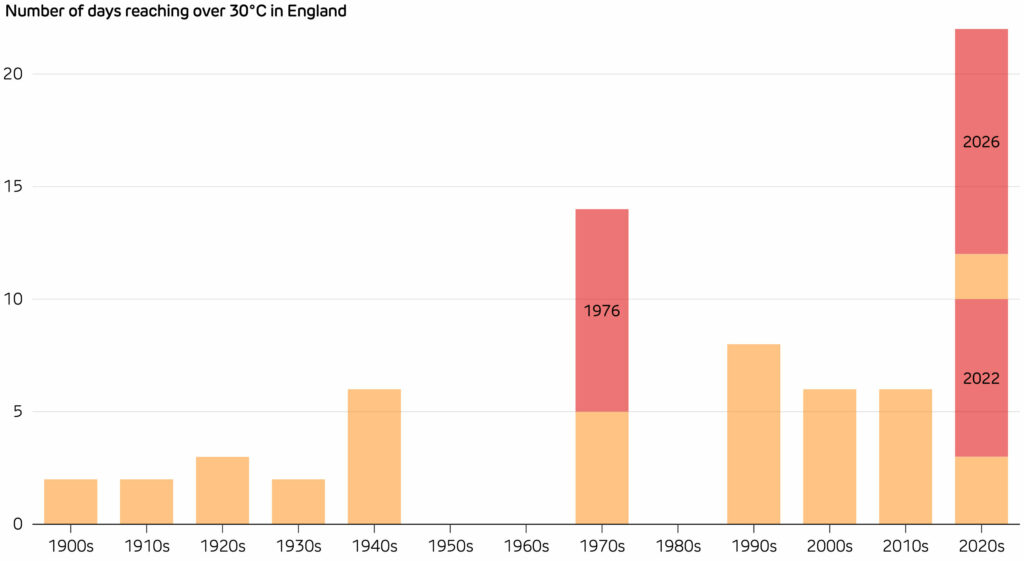
This year alone has already seen more days hit 30°C than in any decade since the 1970s. The three years with most days over 30 are highlighted. Data as of 17 August.
After years of stagnation, Britain’s solar sector has returned to rapid growth. Last quarter saw record generation, surpassing 15 GW on an April afternoon. However, June’s heatwaves exposed what solar cannot provide: output during the heightened evening peak, leaving price spikes until flexibility catches up.
Solar is helping Britain to reduce its need for gas, but recent heatwaves demonstrate both its value and limits. Solar output rises in the morning with demand, keeping down the need for gas during the day and helping meet extra demand from Britain’s growing fleet of air conditioners. But generation falls rapidly towards sunset when demand remains high, especially on hot evenings.
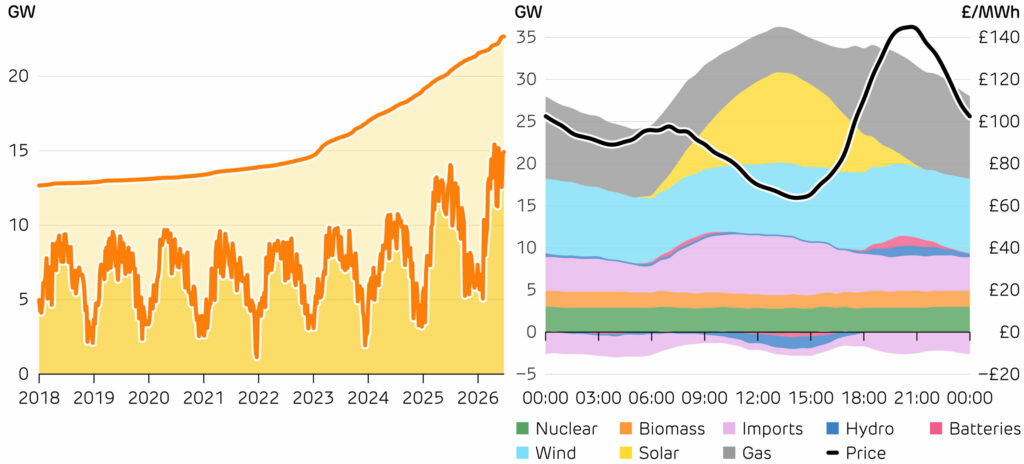
This mismatch is reshaping Britain’s electricity prices. Solar generation pushes down daytime prices as less fossil fuels are needed, deepening the so-called “duck curve”. As solar’s share grows, stretches of negative power prices are becoming longer and more frequent. A MWh produced after 7pm is worth twice as much as one produced at 2pm, so the value of solar now depends on shifting power into the evenings. Solar is becoming a victim of its own success: each new panel reduces the value of electricity from existing ones, and pushes costs onto the rest of the system.
Fixing this requires more flexibility. Batteries and pumped hydro storage each supplied an average of 1.2 GW during evening peaks, but this pales in comparison to the drop in solar output. Britain has many interconnectors, but these export more on average during evenings, as neighbouring countries face the same issue of meeting peak demand.
Batteries already supply over 20% of the evening peak in California, and 7% of peak demand in Australia. Even so, their networks have introduced export limits and emergency controls to curtail rooftop output when midday supply overwhelms demand. The lesson for Britain is that storage must expand alongside solar, not after it. The real test for the coming years is not whether Britain can avoid fossil fuels at noon, but whether solar plus storage keeps the gas-fired power stations off into the evening.
Installed capacity and peak output from solar PV over the past decade. PV output surpassed 15 GW for the first time this quarter.
Britain’s “duck curve”, showing the average grid mix (shaded areas) and wholesale price (line) in each half-hour of the day over June 2026.
Britain has been scorched this summer. June saw more days reach above 30°C than the whole of the 1980s. Kew Gardens recorded a full month without a single drop of rain for the first time in its 150-year history. Britain’s infrastructure is feeling the strain from extreme summer heat, and the power system is no exception. June’s heatwave (the second of five so far this year) saw temperatures peak at a record 37.7°C, which sent wholesale prices soaring, and left the grid worryingly short of supply.
On 23 June, wholesale prices surged above £500/MWh, then the next day NESO issued its first ever summertime Electricity Margin Notice, asking the market to make additional capacity available for the evening peak. Winter is no longer the only season in which Britain must worry about system reliability.
Cooling is one source of pressure. Requests for home air conditioning installations more than quadrupled during the heatwave. Cooling is rapidly becoming a necessity, as hot weather is already costing Britain £1.2 billion a year in lost productivity and 4% of annual learning time in England’s schools. If global warming reaches 2°C, more than one-fifth of Britain’s housing stock will require active cooling to protect people from dangerous indoor temperatures. That would only add 2% to today’s annual electricity demand, so cooling will have little impact on carbon emissions. But as that demand is concentrated in just a few days a year, it can put a serious strain on meeting it at its peak.
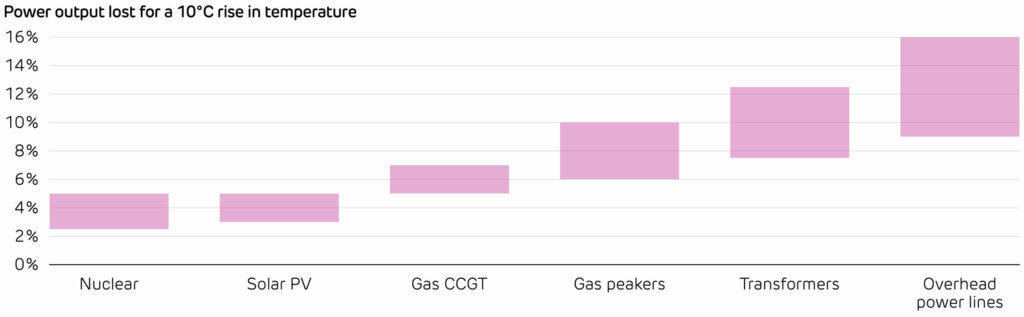
Extreme heat also reduces the maximum output of power stations and the carrying capacity of network assets. Britain’s networks are the most vulnerable part of the energy system, with local grid faults doubling when temperatures exceed 35°C. Climate change could see temperatures in southern England regularly breach 40°C, pushing transformers, cables and switchgear beyond their design conditions. Gas turbines and solar panels become less efficient as air temperatures rise, while nuclear stations can lose efficiency or reduce output as cooling water warms
Most parts of the electricity system operate less effectively when it is hot. Their maximum power rating falls by around 5 to 15% when it is 35°C compared to 25°C.
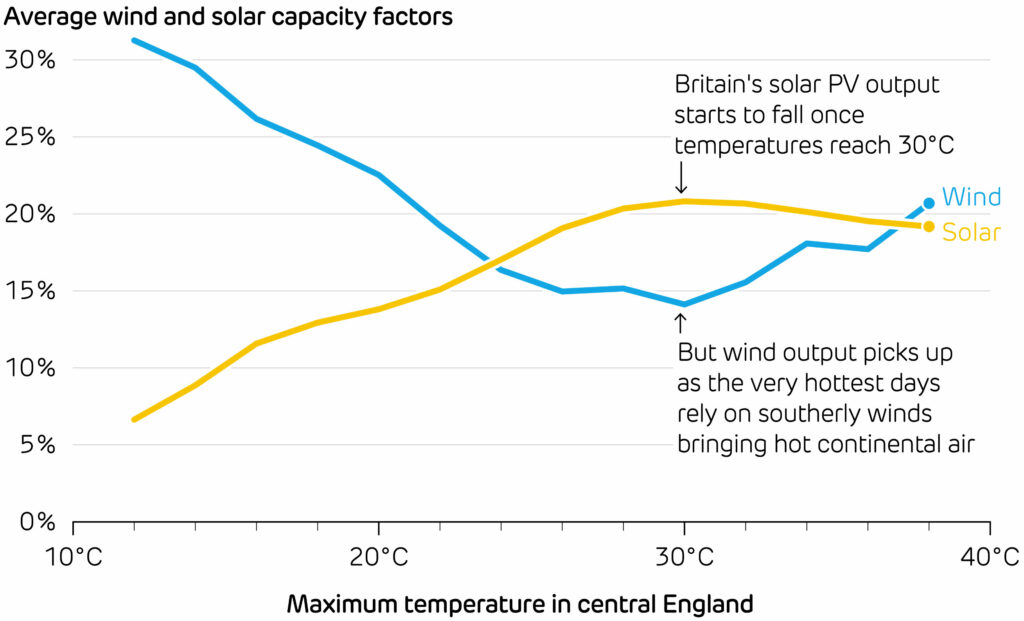
Low wind generation adds to the pressure. Britain’s wind farm output falls sharply during hot, still weather. During the June heatwave, weak wind generation tightened margins just as cooling demand was rising.
Solar offers some relief, supplying much of Britain’s cooling demand during hot, bright afternoons. The tricky period arrives towards sunset, when solar production falls quickly while buildings retain heat and occupants require air conditioning. Other flexible resources must then ramp up quickly to fill the gap.
During the June heatwave, gas-fired power stations stepped in as solar output faded, earning around £10 million from balancing the grid over four days. Interconnectors provided less support than usual because extreme heat was straining electricity systems across Europe. The handling of that week is now under review following whistleblower allegations about operational decisionmaking and record-keeping. NESO maintains that the system remained secure, while Ofgem is overseeing an independent investigation.
Britain’s peak demand will continue to occur in winter for the time being, but cooling could create local pressures where household uptake is concentrated and network capacity is already constrained. Better shading, ventilation, insulation and reflective materials can reduce cooling needs, although active cooling will be required as heatwaves become longer and more intense. A growing need to cool homes could exacerbate existing energy poverty, as the people most vulnerable to overheating live in homes that are difficult to cool and are less able to afford the upfront and running costs of air conditioning units.
The ultimate fix is to limit warming itself, because every fraction of a degree avoided will make Britain’s summers less extreme. But the need to adapt to our changing climate is now unavoidable, and the electricity system is no exception. Futureproofing will require more flexibility, interconnection and heat resilient infrastructure to meet a growing demand for summertime cooling.
The average capacity factor of Britain’s renewables is strongly affected by temperature during the summer months. Data covers the last ten years, and runs to 17 August of this year.
July brought another change at the top of British politics, as Andy Burnham succeeded Keir Starmer as Prime Minister. Burnham inherits a clean power programme that is going strong, with ambitious 2030 targets that are broadly on track. His first moves were to abolish the 5% VAT on household electricity and call for stronger public control over energy. But his larger project is devolution. Britain’s power system offers an early test: can greater regional influence turn an almost £2 billion grid congestion problem into a force for local growth?
Britain operates a national electricity market, but the physical system is highly regional. Wind power is concentrated in Scotland and coastal areas, whereas the largest demands are in the major urban areas of central and southern England. When the network cannot carry enough electricity, clean generation in the north must be turned down and replacement power (typically expensive gas) called upon in the south. This divide comes at a cost, which will only worsen if supply and demand grow in opposite ends of the country.
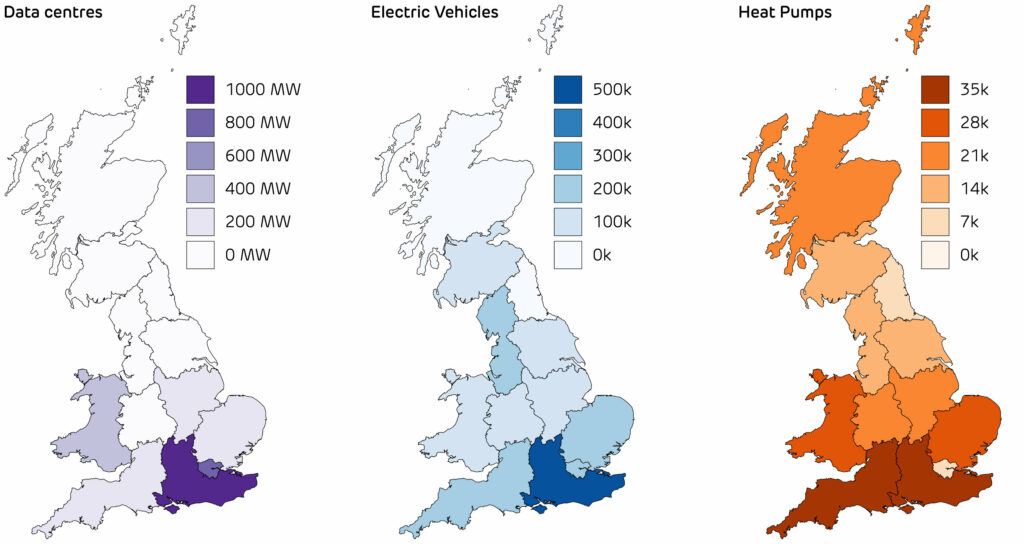
New sources of electricity demand are strengthening this north-south divide. Data centres are growing rapidly and are overwhelmingly concentrated around London. Electric vehicles and heat pumps are also being adopted at very different rates across the country. There are ten times more EVs in the south east than the north east of England, which amounts to more than three times as many per capita.
Some of this new demand is geographically flexible. Households and people’s commutes cannot move, but new data centres, factories and electrolysers for producing clean hydrogen could be steered towards areas with abundant generation or spare network capacity. The billion dollar question is how to persuade new demand and infrastructure to make use of the renewable energy we produce, rather than worsen congestion and push up bills.
The previous government rejected zonal pricing, which would have used regional price signals to influence those decisions. Its forthcoming Strategic Spatial Energy Plan will map where generation and storage are needed, but a map alone will not guide investment. Delivery will depend on whether network charges, connection offers and support schemes give developers sufficient reason to build in those places.
The uptake of “electrotech” is highly uneven around Britain, with data centres and electric vehicles concentrated in the south east of England, and heat pumps in southern England and rural parts of Scotland and Wales.
Britain must build roughly twice as much new transmission infrastructure by 2030 as it managed over the previous decade, alongside up to 27 GW of grid-scale batteries. Building these, along with new renewables and clean capacity, could create 100,000 construction and maintenance jobs, with the government expecting clean-energy employment to almost double by 2030. Where infrastructure is built will shape where jobs appear, but not always where the benefits go, so devolution must ensure that regions capture the benefits of what they host.
Regional Energy Strategic Plans will bring regional and local government into decisions on networks, transport, heating, industry and economic development, with the first full plans expected in late 2027. Local leaders are closer to the communities affected by these decisions. They know where growth is being held back, which investments matter most to local people and which new infrastructure their communities are likely to support or oppose.
Devolving power and directing network investment towards choice sites could bring projects forward, attract further private investment and create jobs. But regions must gain real influence without weakening the national coordination needed to keep power secure and costs down.
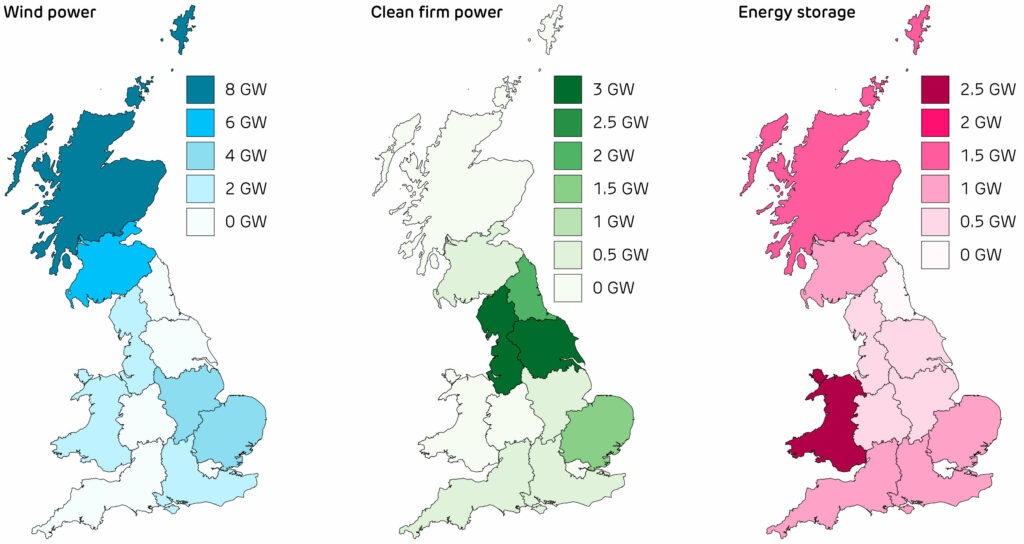
Britain’s electricity generation is also unevenly distributed, and located far from demand centres. Wind farms are concentrated in the north of Scotland. Clean firm capacity(nuclear, biomass, and other low-carbon dispatchable technologies) are primarily in the north of England. Energy storage is more widely distributed, with large pumped- hydro stations in Wales and Scotland.
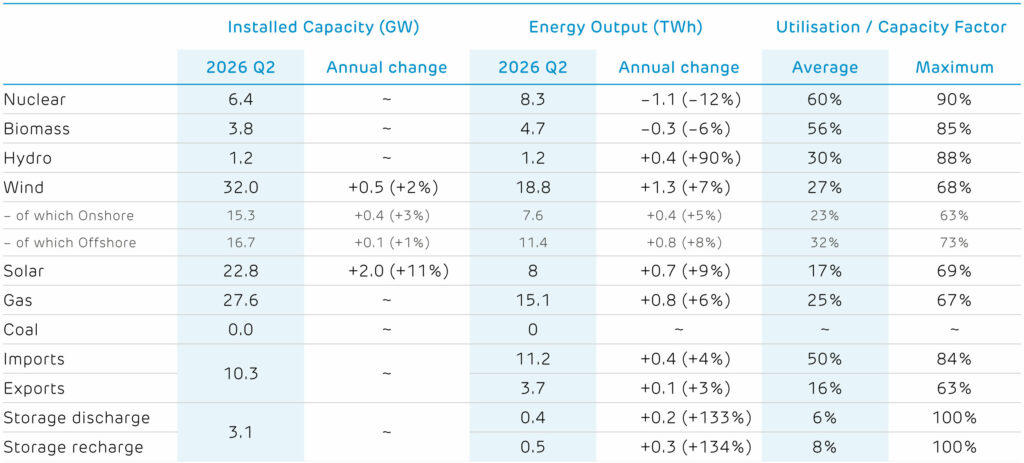
Solar PV was the fastest-growing source of capacity, with the fleet expanding by 2 GW over the last 12 months. The expansion included the 60 MW Gonerby solar farm near Grantham, Lincolnshire, large enough to power more than 15,000 homes.
Wind was Britain’s largest source of electricity for the fifth quarter in a row. Wind and solar output both grew strongly, up 7% and 9% from this time last year. However, gas generation also rose by 6%, driven by the continued growth of electricity demand (up 2.3% year-on-year), and declining nuclear output (down 12%), as the nuclear fleet suffered more unplanned outages than last year.
The drop in nuclear generation also pushed carbon emissions back up from last year’s record low. Britain’s electricity averaged 107 gCO2 /kWh during the quarter, 6% higher than the same quarter last year. Power prices remained elevated too, as tensions around Iran continued to unsettle international fossil fuel markets. Carbon prices added to the pressure, with UK ETS allowances rising from £41 to £55 per tonne between April and July. Wholesale electricity averaged £94/MWh over the quarter, 30% higher than this time last year.
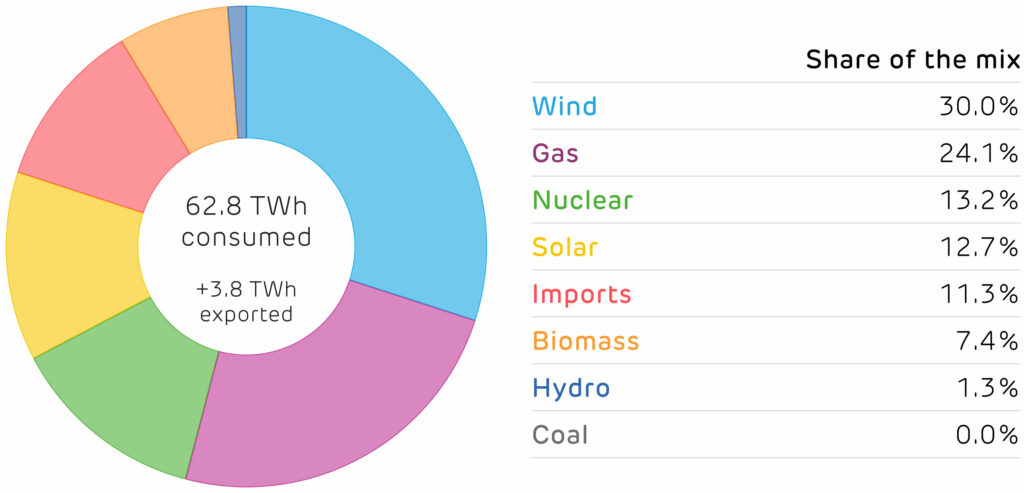
Britain’s electricity supply mix in the second quarter of 2026.
Installed capacity and electricity produced by each technology. (1)(2)
(1) Other sources give different values because of the types of plant they consider. For example, Energy Trends records an additional 0.7 GW of hydro, 0.6 GW of biomass and 3 GW of waste-to-energy plants. These plants and their output are not visible to the electricity transmission system and so cannot be reported on here.
(2) We include an estimate of the installed capacity of smaller storage devices which are not monitored by the electricity market operator.
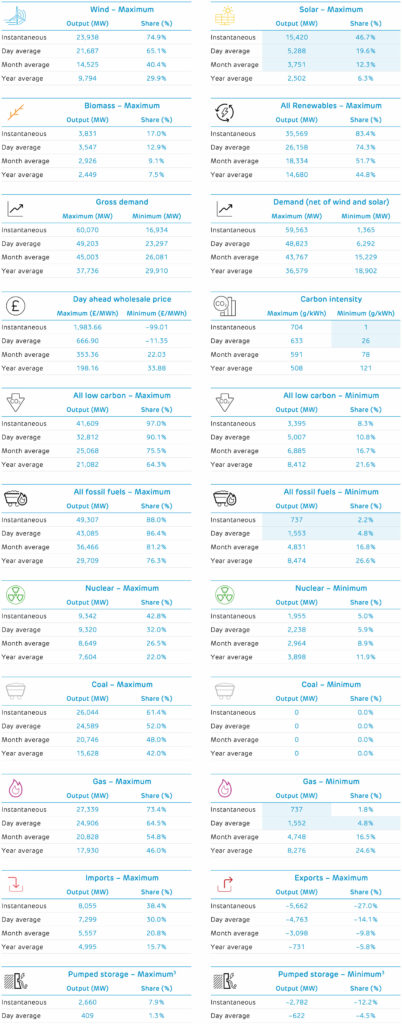
Britain’s power system broke a string of clean energy records during the quarter. Solar power surged past 15 GW for the first time on 23 April, smashing the previous record of 13.2 GW. A month later, solar supplied a record 19.6% of the country’s electricity over the day. Abundant wind and sun also pushed fossil fuels to new lows. Gas output fell to just 737 MW on 22 April, and one week later fossil fuels supplied less than 5% of electricity over an entire day for the first time. These conditions helped drive the carbon intensity of electricity consumed to a low of just 1 g/kWh on the afternoon of 7 April, when renewable output was high and Britain was importing low-carbon power from France while exporting to the higher-carbon Irish grid.
The tables below look over the past seventeen years (since 2009) and report the record output and share of electricity generation, plus sustained averages over a day, a month, and a calendar year. Cells highlighted in blue are records that were broken in the second quarter of 2026. Each number links to the date it occurred on the Electric Insights website, so these records can be explored visually.
(3) Note that Britain has no inter-seasonal electricity storage, so we only report on half-hourly and daily records. Elexon and National Grid only report the output of large pumped hydro storage plants. The operation of battery, flywheel and other storage sites is not publicly available.